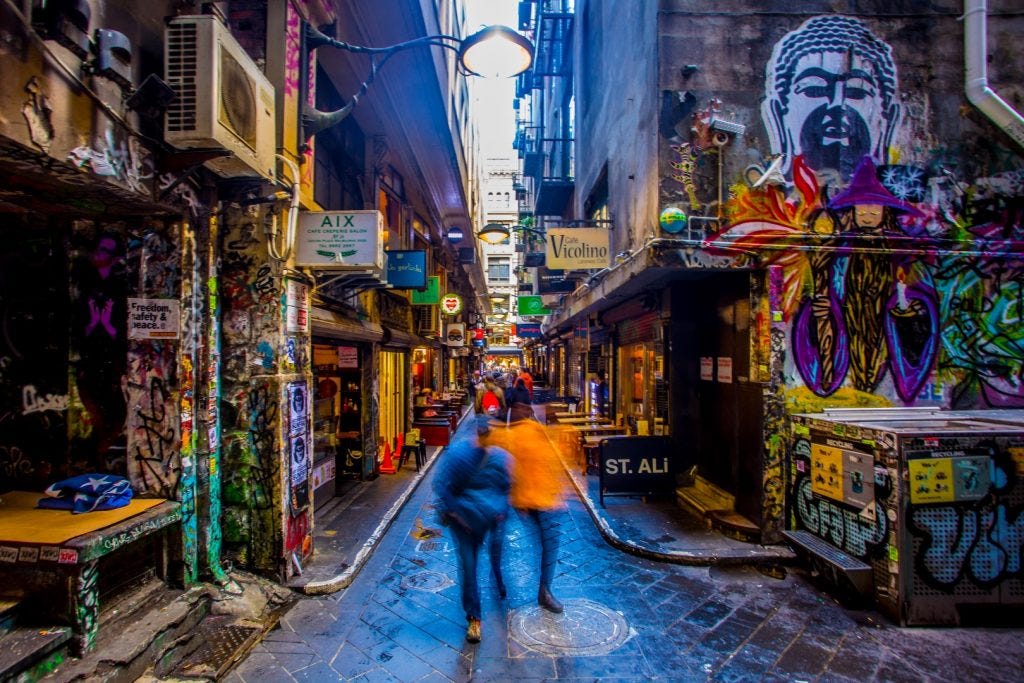
A short walk away lies AC/DC Lane, named after the legendary rock band. The space feels different from Hosier Lane — more intimate, slightly darker, the walls rising high around you. A small gig venue sits tucked in the corner, and posters from long-gone performances fade slowly into the brick. The art here often merges with the surrounding architecture, creating playful interactions: painted figures stepping from doorways, shadows extended by painted silhouettes, musical references scattered like hidden notes. It isn’t unusual to find someone taking photographs with a quiet reverence, as though documenting a story still being written.
Advertising
But Melbourne’s lanes are not defined by art alone. They also house some of the city’s most atmospheric cafes, each shaped by its own story and sense of place. Take Degraves Street, for example. This narrow stretch feels like a blend of European sidewalk culture and Melbourne’s distinct rhythm. Small tables spill onto the pavement, espresso machines hum constantly, and the scent of freshly baked pastries wraps around passersby like a soft blanket. People don’t just drink coffee here — they linger. It’s a place where conversations naturally lengthen, where travelers gather to rest their feet, and where locals read morning news while the crowd rustles around them.
A few streets over is Centre Place, a vibrant corridor where almost every meter offers something intriguing: tiny cafes serving sandwiches on warm bread, juiceries blending fruits right in front of you, handmade jewelry displays, and art pieces integrated into the very texture of the lane. Centre Place feels like the city in concentrated form — youthful, slightly chaotic, and wonderfully sincere. Some murals here are small and easy to miss, hidden between utility pipes or tucked behind window grilles. Finding them becomes a game of attention, rewarding those who look beyond the obvious.
Farther out from the central grid, the laneways begin to shift in character. In Fitzroy, for instance, narrow alleys weave behind Victorian terraces, with murals stretching across multiple walls, sometimes blending with creeping vines or leaning fences. The art here tends to be more experimental, shaped by the local creative scene that has long defined the neighborhood. Small cafes appear unexpectedly: one behind a corner bookstore, another down a side passage where the entrance is marked only by a single hanging plant. Many of these places feel like they were created not to attract crowds but to offer refuge — somewhere to sit quietly with a flat white, to sketch, or to watch the rhythm of the lane.
Meanwhile, in Collingwood, the backstreets tell a different story. Once heavily industrial, the area has been gradually reshaped by studios, galleries, and community-oriented projects. Some lanes retain the roughness of their origins: cracked asphalt, exposed brick, the occasional metal staircase leading to an old warehouse loft. Yet within this industrial frame, new creative life thrives. Small roasting rooms share space with art collectives; designers work behind unmarked doors; soft music drifts from hidden courtyards. Walking through Collingwood’s lanes feels like exploring a working sketchbook where rough edges are part of the charm.
One particularly atmospheric pocket lies near Hardware Lane, a lively street known for dining terraces and evening buzz. But step into the narrow passages branching off it and the tempo softens. Here you might find miniature galleries, whimsical window displays, or a tiny espresso bar run by a single barista who knows half the regulars by name. These micro-spaces rarely appear in travel guides; they exist without fuss, adding layers of intimacy to the city. Some stay for years, others vanish quietly, their footprints replaced by new ideas and new owners.
Melbourne’s hidden lanes also reveal unexpected intersections of cultures. A tiny noodle shop shares a wall with a specialty tea bar; a bakery offering warm sourdough sits opposite a florist who creates compact arrangements from native plants; a small record shop operates from what was once a back entrance to a printing warehouse. These juxtapositions create a sense of conversation between eras and influences. The lanes become places not of competition but coexistence, where variety feels natural rather than curated.
The experience of walking through these passages is deeply sensory. The echo of footsteps shifts from stone to brick, then to smooth pavement. Smells shift as well: roasted beans, toasted bread, citrus peels, fresh paint from a new mural. Sunlight enters unevenly, filtered between high walls or caught on metallic signs. Even the sounds of the city change — trams clatter at the street corners, but within the lanes, voices soften, as though the walls themselves absorb the noise. It’s in these small details that the laneways’ charm becomes fully felt.
For many locals, exploring these lanes is not a one-time adventure but a ritual. A new mural appears, a café changes its menu, a temporary installation pops up, or a small shop opens without fanfare. Each return visit reveals something new. This constant renewal keeps the lanes alive, shaping them into a living reflection of Melbourne’s creative character.
What makes these places truly special is that they don’t demand attention. They invite discovery. Nothing in a hidden lane insists that you stop and admire it; instead, the city rewards those who wander, who follow curiosity rather than direction. Some visitors say they find the lanes by accident, but in truth, the lanes find them — offering a doorway into a slower, more personal version of the city.
There is also a sense of community woven through these spaces. Artists often paint with onlookers nearby, sharing conversations about technique or meaning. Café owners greet returning customers with easy warmth. Shopkeepers explain the stories behind locally made objects. Even the simple act of passing by someone else in a tight space creates a brief moment of connection: a smile, a nod, a shared appreciation of the lane’s atmosphere.
In a world where cities often promote their biggest attractions, Melbourne’s laneways rely on the small and the subtle. That is their strength. They hold memories in the uneven paint layers, the worn cobblestones, the handwritten chalk menus, and the quiet corners where someone might be reading under a patch of sunlight. They offer spaces for pause in a place that never stops moving.
To explore Melbourne is to explore these lanes — to step away from the main roads and follow whichever path looks intriguing. The reward is not just what you find, but how you find it: slowly, with curiosity, and with the sense that the city is revealing itself piece by piece. The small cafes and unexpected art corners are only part of the story. The rest unfolds as you walk, turn, pause, and let the city show you its quieter heartbeat.