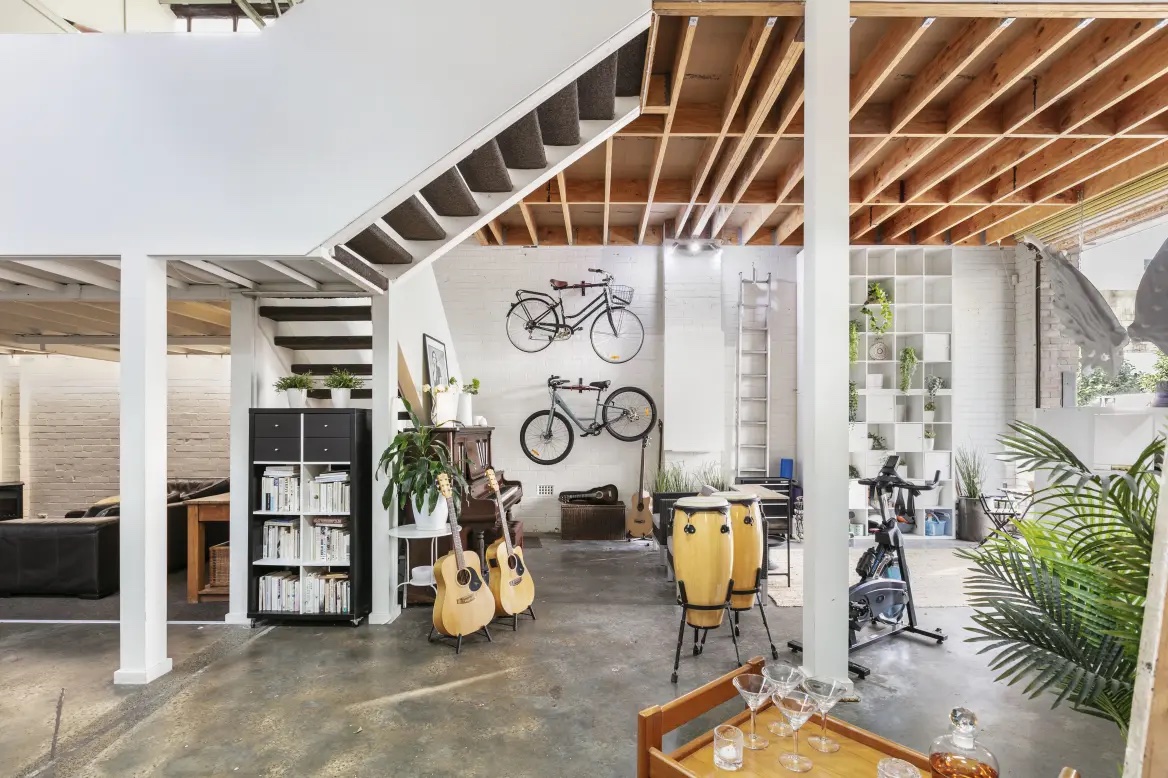
Just a short walk away, Redfern reveals another layer of this story. Once known primarily for its industrial yards and railway infrastructure, the neighbourhood has gradually become home to photographers, dancers, musicians, writers, and digital creators. Many of Redfern’s warehouses date back more than a century, built with solid materials meant to withstand heat, machinery, and constant foot traffic. Their durability created an unexpected advantage: these rooms could be reorganized endlessly, responding to the needs of new occupants without losing their original character.
Advertising
Some of the most distinctive studios in the area occupy buildings that still carry marks of their industrial past — pulley systems attached to beams, faded stencilled numbers above doors, metal fixtures worn smooth by decades of use. These remnants give each workspace a quiet depth, reminding everyone inside that they are part of a longer story. Instead of erasing history, many creative groups deliberately preserve it, allowing old structural elements to frame contemporary work.
A particularly inspiring example lies in Marrickville, a suburb long connected to Sydney’s manufacturing history. Its streets are lined with factories that once produced furniture, textiles, tools, and household goods. When manufacturers began relocating, these structures didn’t lose their purpose — they simply gained new ones. Today, Marrickville has an unusually high concentration of music studios, ceramic workshops, independent breweries, theatre rehearsal spaces, and multidisciplinary creative collectives.
What sets Marrickville apart is the sense of community that emerged naturally from these shared spaces. A musician rehearsing in one building might step out for a break and cross paths with a sculptor unloading clay or a filmmaker testing equipment. Small conversations often lead to collaborations, and projects that start informally grow into substantial artistic ventures. Many locals will tell you that the suburb’s creativity thrives not because of formal planning, but because of people who chose to build something together inside places others had forgotten.
In Alexandria, a similar pattern unfolds, though in a slightly different rhythm. Large warehouses once used for distribution and production now hold design studios, photography spaces, furniture workshops, and showrooms. Unlike districts where redevelopment is tied closely to residential growth, Alexandria maintains a strong connection to its industrial roots. Wide roads, large blocks, and the presence of ongoing light industry make the suburb feel like a bridge between old and new uses of space.
Creative businesses here benefit from the generous proportions of these buildings. Photographers value the height of ceilings and the controlled light that can be shaped within massive rooms. Designers appreciate the possibility of constructing full-scale prototypes without spatial limits. Furniture makers, textile artists, and metalworkers can produce larger pieces safely and comfortably. The openness of warehouse layouts invites experimentation, enabling creators to reorganize their space whenever a new idea requires it.
Across all these suburbs, one theme consistently appears: adaptation without erasure. Instead of demolishing the past, Sydney’s creative communities inhabit it, reshape it, and reinterpret it. The buildings remain recognizable — the brick, the steel beams, the warehouse windows that filter daylight in soft, diffused patterns. But the atmosphere inside them evolves with every new workshop, exhibition, or rehearsal. The result is a textured blend of old and new that feels authentic to Sydney’s identity.
Another key element in this transformation is how warehouses support interdisciplinary work. The spacious layouts promote interaction among different creative fields. Graphic designers share buildings with ceramicists; sound engineers work next to visual artists; theatre groups rehearse near photographers editing portfolios. This proximity encourages a kind of accidental cross-pollination. A passing comment, a shared wall, or a borrowed tool can spark an idea that pushes a project in an unexpected direction.
Sydney’s universities have also played a role in this shift. Graduates from art, design, film, music, and architecture programs often seek workplaces that allow them to collaborate informally. Warehouse studios offer that flexibility. Teams can expand, contract, or reorganize without the limitations of tight office floor plans. This adaptability becomes crucial for early-stage creatives who may juggle multiple projects, funding cycles, and evolving team compositions.
But the transformation of these industrial buildings isn’t limited to professional artists. Many warehouses open their doors to the wider community through workshops, exhibitions, open studios, and performances. This accessibility has given residents a chance to engage with creative processes directly. Visitors might attend a clay workshop, listen to a rehearsal session, join a local maker’s market, or watch a work-in-progress theatre piece. These interactions strengthen the connection between neighbourhoods and the people shaping their cultural landscapes.
The involvement of local councils has added yet another layer. While the earliest stages of warehouse repurposing happened organically, several councils now encourage the preservation of industrial heritage through adaptive reuse. They support initiatives that maintain the architectural character of old buildings while enabling new, culturally meaningful uses. These efforts help ensure that redevelopment doesn’t erase the qualities that make these spaces valuable in the first place.
Sydney’s creative warehouse scene continues to evolve. Buildings that once echoed with the sounds of machinery now host music rehearsals, film shoots, collaborative design projects, and experimental performances. Walls that once supported shelves of goods now hold canvases, lighting rigs, digital screens, or exhibitions. Floors that once bore the weight of crates now support dance rehearsals, installations, and community events. The shift is not merely functional — it reflects a changing understanding of what these spaces can be.
What makes this transformation especially compelling is how it demonstrates the city’s ability to reinterpret its past. Industrial history is not presented as something fragile or fenced off behind museum glass. Instead, it lives on in the day-to-day actions of people who create, learn, and share inside old walls. The stories embedded in these buildings mix with new ones, creating environments that feel layered, grounded, and constantly alive.
As more residents discover the charm of these adaptive spaces, warehouses continue to attract new types of creative work. Digital creators, craft specialists, cultural organizers, small production teams, and independent publishers find room to grow in their own rhythms. The buildings give them space to pace, experiment, build, and rearrange their ideas. They offer something many modern workspaces lack — a sense of freedom shaped not just by what the room contains, but by what it has survived.
Walking through these neighbourhoods today reveals a city that remembers its industrial heritage not with nostalgia, but with renewed purpose. The old warehouses of Sydney no longer store goods. They store ideas, projects, collaborations, and the steady pulse of creativity that flows between people who choose to make something meaningful together.